
Pavement Engineering
Roads 101

The story of the American road is often told as a triumph of grit and steam a steady march from the Great American Mud to the sleek endless ribbons of the mid century. But beneath the asphalt lies a more complex narrative of calculated displacement and structural rigidities. As we stand at a technological threshold we have the opportunity to move toward a poised future where engineering is driven by a profound awareness of the landscape and the technical enablement of circularity for the next century.
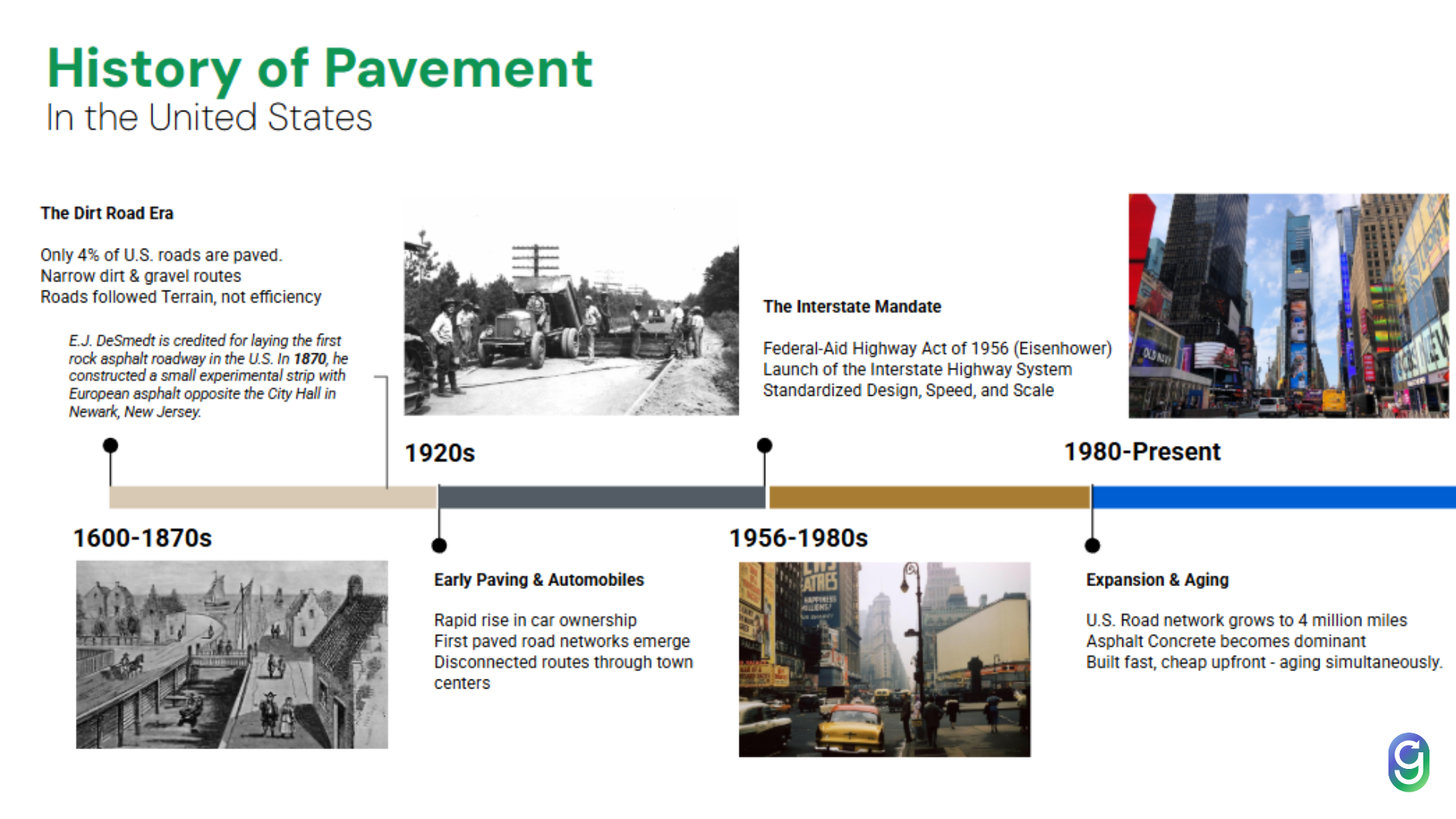
From Good Roads Mud to the Concrete Canopy
At the turn of the 20th century America was a nation stuck in the mire. Outside of major cities roads were primitive dirt tracks that rain transformed into impassable bogs effectively blockading farmers from markets and doctors from patients. This led to the Good Roads Movement a crusade originally led by bicyclists and later joined by motorists who lobbied for a hard surfaced escape from the mud.
The tipping point arrived with President Dwight D. Eisenhower. When taking office in 1953 the states had only completed 6,500 miles of the system Improvements from the Federal-Aid Highway act of 1944 that were intended to fund a 40,000 mile "National System of Interstate Highways" Driven by his experience of the U.S. Army's first 1919 Transcontinental Motor Convoy which took 62 days to cross the country from Washington D.C. to San Francisco, California. He also was impressed by the German Autobahn and their advantage during World War II. Eisenhower envisioned a standardized paved network for national security. He pushed for the Federal Aid Highway Act of 1956 authorizing a then unprecedented $25 billion to construct 41,000 miles of interstate. It was the largest public works program in human history designed to replace the patchwork of muddy trails with a uniform concrete canopy (Mohl, 2018).
However this Grand Plan frequently prioritized the movement of goods and suburban commuters over the human requirements of urban centers. In many instances economic flow served as a veneer for intentional segregation. Engineering became a tool of surgical displacement as planners used federal funds to route interstates directly through vibrant minority neighborhoods under the guise of slum clearance effectively weaponizing the road to isolate or destroy Black and Brown communities.
The Human Cost of Progress
The legacy of this expansion is etched in the displacement of over one million Americans:
-
Los Angeles, CA: The I-10 was carved through Sugar Hill an epicenter of Black prosperity. Further east the massive East LA Interchange fractured Boyle Heights displacing 15,000 residents to protect the property values of more politically connected enclaves (Archer, 2020).
-
St. Paul, MN: The I-94 expansion plowed through the Rondo neighborhood once the heart of the city’s Black middle class. It shuttered 300 businesses and stripped away an estimated $270 million in generational wealth (Reconnect Rondo, 2021).
-
New York, NY: Robert Moses’s Cross Bronx Expressway effectively walled off the South Bronx. To sustain this massive concrete footprint Hot Mix Asphalt (HMA) plants were frequently sited within these same marginalized corridors such as the heavy industrial zones in Port Morris and South Queens exposing residents to decades of particulate matter and industrial runoff (Ullmann & Douglas, 2024).
The 200 Million Ton Monument to Inefficiency
For the last century the industry has relied on a linear extractive model: mining virgin stone refining oil based binders and hauling millions of tons of debris. This has resulted in a staggering stockpile of road waste. Traditional processes generate a rip and replace cycle that treats old roads as liabilities rather than assets. In the United States alone we generate an estimated 170 million tons of Reclaimed Asphalt Pavement (RAP) waste every single year.
Currently these massive stockpiles sit in industrial yards often underutilized because traditional plants struggle to incorporate high percentages of RAP without compromising structural integrity. This inefficiency requires constant heavy vehicle hauling an ongoing disablement for the communities forced to live near the noise of haul routes and the pollution of industrial processing.
The Technical Enablement: In Place Circularity
We now possess the tools to correct this process. The shift to a poised future requires moving beyond the HMA plant and toward cold recycling. We can now reconstruct roads using the materials already in the ground. By using Full Depth Reclamation (FDR) or Cold in Place Recycling (CIR) or utilize offsite stockpiles with Cold Central Plant Recycling (CCPR) combined with bio-based non petroleum binders we regenerate the road without the carbon heavy footprint of traditional refining or the need for oil based products.
Crucially this technology allows a road to be recycled in place multiple times. By re- engineering the same footprint over and over we prevent the environmental and social impacts of further expansion and rip and replace cycles. We are finally aligning the economic priorities of the state with the human requirements of the people.
Reversing the Inefficiency of the Past
A strategic investment to transition road construction now is the only way to save municipalities from the compounding costs of the past. By adopting circularity on a widespread basis we achieve:
-
Direct Fiscal Savings: Recycling in place eliminates the exorbitant costs of hauling and virgin material purchase. This allows cities to repair 10x more miles of road within the same budget.
-
Environmental Stewardship: Less mining and fewer industrial plants mean cleaner air for the very communities that have historically carried the industrial burden of our transit system.
-
Restorative Engineering: The savings generated by circularity provide the capital needed for reconnection projects the construction of land bridges and transit hubs that heal the physical scars of the Eisenhower era (U.S. DOT, 2024).
Our Mission
To repair the physical and economic fractures of the past through the technical enablement of circular infrastructure. By transforming the road itself into a renewable asset we eliminate waste empower municipalities with fiscal resilience and ensure that the next century of American transit serves as a bridge for every community not a barrier.
Building for 2126
We are already seeing this restorative vision take root. In Los Angeles the Destination Crenshaw project is reclaiming the streetscape once divided by transit lines while in Minnesota the federal Reconnecting Communities Pilot Program is funding land bridges to finally restore connectivity to the Rondo neighborhood (U.S. DOT, 2024).
The next 100 years of infrastructure should not be a burden for our grandchildren to pay off but a resilient and mobilizing asset for them to maintain. By perfecting circularity now we ensure that our roads are no longer barriers but bridges built with the technical poise to handle the future and the wisdom to honor the past.
Research References
-
Mohl, R. A. (2018). The Interstates and the Cities: Highways, Housing, and the Freeway Revolt. Poverty & Race Research Action Council.
-
Archer, D. N. (2020). "White Men's Roads Through Black Men's Homes": Advancing Racial Equity through Highway Reconstruction. Vanderbilt Law Review, 73(5).
-
Reconnect Rondo. (2021). The Rondo Restorative Act Report: Quantifying Generational Wealth Loss.
-
U.S. Department of Transportation. (2024). Reconnecting Communities and Neighborhoods (RCN) Grant Program: Award Summaries.
-
Aiello, L. M., et al. (2024). Urban highways are barriers to social ties. Proceedings of the National Academy of Sciences (PNAS), 122(10).
-
Ullmann, L., & Douglas, G. (2024). Beneath I 280: Excavating a Neighborhood Lost to San José Freeways. Mineta Transportation Institute.